


Haa At.óowu (Our Sacred Clan Objects.)
- Buster Landin (He/him)

- Jun 11, 2021
- 4 min read
Updated: Aug 23, 2021
I began the development of my PhD research project in archaeology with the Purdue University Department of Anthropology to examine the evolution of fish catching technology in southeast Alaska using the standard Western scientific approach. I learned that the preferred fish catching technology was the fish weir and has been for approximately the last 5,000 years. Their importance is reflected in the sheer number of sites found in the region, there are estimates of 1,200 sites in unpublished data and nearly 500 sites in published data (Smith, 2011). A fish weir is a highly adaptable structure with linear to curvilinear sloping piles rocks 3’ high and 3’ wide at the base. It may include wooden, fence-like structures that allowed the Tlingit to selectively and sustainably targeted all five species of x̱áat (salmon) and aashát (Steelhead) (Langdon, 2006). The importance of salmon streams and the reliance on salmon as an essential food source is central to the Tlingit culture.
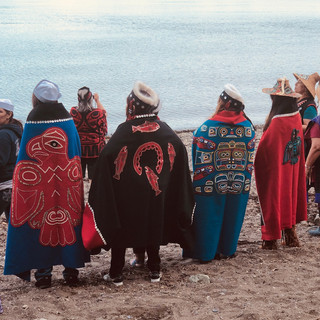
It was not readily apparent during my research (even though I am part of the community I intended to study) that my culture held a key with which to develop a culturally sensitive guide to conducting research. Through the interpretation of tensions between Western and Indigenous ways of seeing, I was able to build a framework for my research using the Tlingit concept of at.óow [at-∅-√.óow] (Twitchel, 2016). At̂̂.óowu invokes emotional content, value, and respect the Tlingit culture imparts to clan names, stories, songs, salmon streams, regalia, the Tlingit language, and places (Twitchel, 2016). These cultural riches as a whole are communally owned and cannot be claimed by an individual are called Haa At̂̂.óowu (Our Sacred Clan Objects) (Dr. Rosita Worl, personal communication).
At̂̂.óow will inform the methods of conducting my research; including data collection, analysis, storage, and return of data and stories back to the clan(s), native villages, and other native entities. I will curate this knowledge in the fashion they choose. In practical terms, the at̂̂.óow(u) people share will be accepted in the manner in which they are given: as at̂̂.óow. I believe it is not my place, nor that of any other researcher, to attempt to validate the observations, facts of the story, or try to determine the legitimacy of insights shared through the lens of Western science epistemology because it has already been validated through the Indigenous world view and epistemology.
How should a researcher contend with encountering and/or studying Indigenous knowledge (IK)? IK, sometimes referred to as traditional ecological knowledge (TEK), is often revered in the communities the wisdom inhabits. The researcher should be authentic when meeting and operating with these different ways of knowing, be transparent, work for the community, and use approaches in their research that are informed by the community, especially when entrusted as a caretaker of IK.
Some Native scholars have renamed IK or TEK and now refer to it as Native Science, illustrating and emphasizing the legitimacy and rigor of this knowledge. This knowledge lives today as a result of iterative, accumulation, and refinement of intergenerational lived experiences that have stood the test of time, thought, and experimentation for millennia. IK provides direct feedback from observations of the landscape, but it also elucidates the intersectionality of landscapes and the formation of place by people. It encourages connections between people and place, imparting animacy to the plants, animals, and land that is central to Indigenous wellbeing and culture. Within the realm of IK and ways of being not only provides for wellbeing and living a good life but is also as a contemporary epistemology that remains a validated source of knowledge within tribal communities (Cajete, 2000).
The difficulty some researchers may face when working from within the Western scientific epistemological world views while also trying to interpret and use Indigenous ways of knowing is highlighted by scholars that situate this body of knowledge squarely in opposition to many, if not all, current dominant societal structures. IK and ways of knowing permits animacy of seemingly inanimate non-human beings and nurturing those relationships. IK is thus so far out of the mainstream epistemology that Dr. Kim TallBear labeled her work with IK as “queer (in)humanisms. Although to be clear, from an indigenous standpoint, my work should not be seen as queering indigenous practice. Rather it should be seen as twenty-first-century indigenous knowledge articulation, period (Muñoz et al., 2015).” Collaborating with Indigenous colleagues and communities is vital in navigating the nuances of working with and interpreting these world views.
I plan to continue to use this research model while here at Purdue University, but I also intend to use this model for all my future projects. I believe this model of research could be adopted by other researchers and have a far-reaching effect through this approach supporting the equality of Indigenous knowledge and native science with Western world views.
References
Cajete, G. (2000). Native Science: Natural Laws of Interdependence. Santa Fe, N.M.: Clear Light Publishers.
Langdon, S. J. (2006). Traditional knowledge and harvesting of salmon by Huna and Hinyaa Tlingit. U.S. Fish and Wildlife Service, (43), 194.
Muñoz, J. E., Haritaworn, J., Hird, M., Jackson, Z. I., Puar, J. K., Joy, E., … Halberstam, J. (2015). Theorizing Queer Inhumanisms. GLQ: A Journal of Lesbian and Gay Studies, 21(2–3), 209–248. https://doi.org/10.1215/10642684-2843323
Smith, J. L. (2011). An Update of Intertidal Fishing Structures in Southeast Alaska. Alaska Journal of Anthropology, 9(1), 1–26.
Twitchel, X. L. (2016). Tlingit Dictionary (First Edit). Juneau, Alaska: University of Alaska Southeast; Goldbelt Heritage Foundation.
Worl, R. (2021). Personal Communication. Meeting Sealaska Heritage Foundation, Juneau Alaska.











Comments